

Less is More? SEC Proposes Comprehensive Rewrite of Item 402 Executive Compensation Disclosure Rules
Overview
On November 13, 2026, the Securities and Exchange Commission (the “SEC”) proposed a comprehensive revision of Item 402 of Regulation S-K, which governs executive and director compensation disclosure (the “Proposal”). The 542-page proposing release follows the SEC’s review of Item 402, which included a roundtable on June 26, 2025 and a related request for public comment. The SEC describes the Proposal as an effort to make the disclosure requirements more principles-based and materiality-driven and to reduce compliance burdens where there is no commensurate benefit to investors. If adopted, the Proposal would, among other things: (i) limit the named executive officer (“NEO”) group to the principal executive officer (the “PEO”) and the principal financial officer (the “PFO”); (ii) replace the Summary Compensation Table and the other currently required tables with three new tables; and (iii) significantly scale back the pay-versus-performance, pay ratio and clawback disclosures adopted under the Dodd-Frank Wall Street Reform and Consumer Protection Act (the “Dodd-Frank Act”).
Chairman Paul S. Atkins described the Proposal as the second of three “pillars” of his agenda to rebuild the SEC’s public company disclosure regime around materiality. The first was the SEC’s May 2026 proposal to simplify filer status and expand scaled disclosure (discussed below). The SEC is working on the third, which would address the business, risk and governance disclosure requirements of Regulation S-K. For additional information, please see the proposed rule and fact sheet published by the SEC.
Key Takeaways
- The Proposal would be the first comprehensive overhaul of Item 402 since the 2006 amendments that introduced the Compensation Discussion and Analysis (the “CD&A”).
- NEOs would be limited to the individuals who served as PEO or PFO during the last completed fiscal year, which would also have the effect of narrowing Item 5.02 of Form 8-K and other disclosure requirements.
- Three new tables (the Granted Compensation Table, the Earned Compensation Table and the Status of Equity Awards Table) would replace the Summary Compensation Table and other existing tables, while the Pension Benefits and Nonqualified Deferred Compensation Tables would be eliminated. Quantitative disclosure of Potential Payments Upon Termination or Change-in-Control would be eliminated.
- The perquisite reporting threshold would increase from $10,000 to $150,000. The SEC would remove the examples of items requiring disclosure as perquisites or personal benefits, including security provided at the executive’s personal residence or during personal travel.
- The CD&A would focus on three required topics (down from the current seven), and the existing list of 15 illustrative topics would be eliminated.
- Pay-versus-performance disclosure would be based on the new Earned Compensation Table and cumulative total shareholder return alone. Pay ratio disclosure would be based only on U.S. full-time employees. Clawback check boxes would be eliminated, although the underlying clawback policy requirements would not change.
- If adopted, the Proposal would become effective on the next January 1 after publication of the adopting release in the Federal Register. Therefore, if the adopting release is published in 2027, the effective date would be January 1, 2028 and compliance would be required for the first full fiscal year ending on or after that date (although companies could elect to comply at any time after the effective date).
Summary of the Proposal
Named Executive Officers
Under the current version of Item 402, the NEO group generally consists of each individual who served as PEO or PFO during the year, the three most highly compensated other executive officers serving at year-end and up to two former executive officers who would have been among the three most highly compensated executive officers but for the fact that such individuals were not serving as executive officers at year-end. The Proposal would limit the NEO group to only the PEO and PFO, regardless of compensation level. Companies could voluntarily include other executives in the new tables, but only if they provide the full tabular disclosure for each such person, and those executives would not become NEOs for other purposes.
The SEC’s rationale is that PEO and PFO compensation is generally the most material to investors given those officers’ central roles in managing the company. The SEC notes that this change would eliminate the need to calculate compensation for a larger group of executives simply to determine which three are the most highly compensated for purposes of Item 402. However, companies may still be required to perform such calculations for purposes of the $1 million annual compensation deduction limit under Section 162(m) of the Internal Revenue Code of 1986, as amended (the “Code”).
The change would reach well beyond the compensation disclosures in the proxy statement because other rules incorporate the NEO definition.
- Under the Proposal, Form 8-K Item 5.02(e) reporting of compensatory arrangements would no longer be triggered for executive officers other than the PEO and PFO, and Item 5.02(b) departure reporting would continue to apply only to the other officers whose titles are named, such as the president, principal accounting officer and principal operating officer.
- The beneficial ownership table would list only the PEO and PFO individually among the executive officers (the group total would remain), and golden parachute disclosure and the related advisory vote would cover only the PEO and PFO.
- Compensatory arrangements with other executive officers would no longer be automatically deemed material for exhibit filing purposes, but may still need to be filed unless immaterial in amount or significance. In addition, because the say-on-pay vote relates to the compensation disclosed under Item 402, it would cover only the PEO and PFO.
The narrower definition would not affect certain rules that use their own definitions. For example, clawback policies under Rule 10D-1 of the Securities Exchange Act of 1934, as amended (the “Exchange Act”), would continue to cover all executive officers.
Compensation Tables
The Proposal would split the information now reported in the Summary Compensation Table into two tables, one showing what was granted and one showing what was earned, and would add a third table tracking each equity award from grant to vesting or exercise. Together, the three tables would replace the Summary Compensation Table, the Grants of Plan-Based Awards Table, the Outstanding Equity Awards at Fiscal Year-End Table and the Option Exercises and Stock Vested Table. The Pension Benefits Table and the Nonqualified Deferred Compensation Table would be eliminated. In place of many of today’s prescribed footnotes, companies would need to disclose any material information necessary to understand the tables, in whatever format they choose.
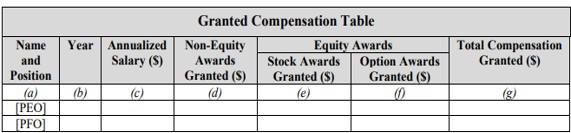
- Granted Compensation Table. This table would show annualized salary, non-equity awards (including cash bonuses) and equity awards granted during each year, generally at target. Equity awards would still be valued at grant date fair value under FASB ASC Topic 718, but assuming target performance rather than the probable outcome. Where the target and probable outcomes diverge, as with a “moonshot” award, companies would need to explain the difference if it is material. A company could also elect to report an equity award granted in the first quarter of a year in the prior year if the award is for performance in that prior year. This election would address the long-standing mismatch between annual bonuses, which are reported for the year earned, and equity awards made for the same year, which are reported in the year granted. A company making the election would need to apply the election consistently across years and would need to disclose that it made this election. Below is the form Granted Compensation Table from the Proposal.
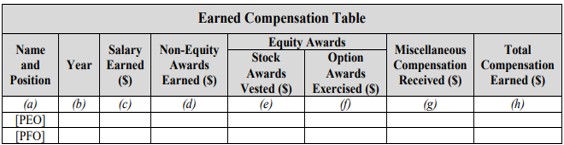
- Earned Compensation Table. This table would show compensation earned or received during each year, including salary, non-equity awards (e.g., cash bonuses), stock awards (valued on vesting), option awards (valued on exercise) and a single miscellaneous column for perquisites, tax gross-ups, retirement plan contributions, severance and similar items. For defined benefit and supplemental retirement plans, the table would include service cost and prior service cost for the year rather than the change in the actuarial present value of the benefit. The total from this table would also serve as “compensation actually paid” for pay-versus-performance purposes. Below is the form Earned Compensation Table from the Proposal.
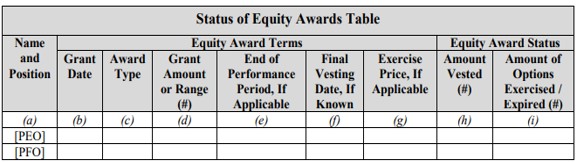
- Status of Equity Awards Table. This table would follow each equity award individually, beginning with the year of grant and continuing until the award vests, is exercised or expires, so that investors can trace an award through its full life. Awards would be shown in numbers of shares rather than dollar values, and companies would no longer need to revalue outstanding awards each year. Below is the form Status of Equity Awards Table from the Proposal.
As under the current rules, the Granted and Earned Compensation Tables would generally cover three fiscal years (two for smaller reporting companies (“SRCs”) and emerging growth companies (“EGCs”)). Large accelerated filers would be required to tag the three tables in Inline XBRL.
Perquisites
The Proposal would raise the aggregate threshold for reporting an NEO’s perquisites from $10,000, a level unchanged since 2006, to $150,000. In measuring against that threshold, companies would be able to disregard any individual item that qualifies as a de minimis fringe benefit under Section 132(a)(4) of the Code, so those items would no longer need to be tracked. Companies also would no longer be required to value perquisites at aggregate incremental cost and could, for example, use the value already determined for tax purposes.
In addition, the SEC would revise its 2006 interpretive guidance on what constitutes a perquisite. The two-part test would remain, so an item would not be a perquisite if it is “integrally and directly related” to the performance of the executive’s duties. However, that determination would be the company’s to make, so long as it is reasonable and made in good faith. The SEC would also withdraw its 2006 examples of items that are perquisites, including security at an executive’s residence or during personal travel, and the Proposal states that companies should look to the revised guidance rather than prior SEC enforcement proceedings. As an example, the Proposal states that if a company reasonably concludes in good faith that its requirement that its PEO or PFO have around-the-clock security or use company aircraft for personal travel for security reasons is integrally and directly related to the executive’s duties, the benefit would not be a perquisite.
Executive security has become a significant issue for many boards, and commenters told the SEC that the current guidance can discourage companies from providing needed protection. A study cited in the Proposal found that the share of S&P 500 companies disclosing off-the-job security for their CEOs rose from 31.0% in 2014 to 46.4% in 2024.
Compensation Discussion and Analysis
The CD&A would be refocused on three required topics (replacing the seven topics required today): (i) the objectives of the company’s compensation program in relation to its corporate strategy; (ii) the material elements of compensation and how those amounts are determined; and (iii) if applicable, whether the company considered the results of the most recent say-on-pay vote in determining compensation policies and decisions and, if so, how that consideration affected those policies and decisions.
The list of 15 example topics, which includes benchmarking, the allocation between cash and non-cash pay and the role of executive officers in pay decisions, would be eliminated. The SEC is concerned that the list has led companies to treat every topic as mandatory, regardless of materiality. The requirement to tie program objectives to corporate strategy is new, and companies should expect investors to look for disclosure that goes beyond generic statements about attracting, retaining and motivating talent.
The Proposal would also add a new requirement, applicable throughout Item 402, for companies that disclose a non-GAAP target level or company-selected performance measure. If the measure is based on historical results, the company would need to provide a quantitative reconciliation to the most directly comparable GAAP measure. If it is a projected measure, the company would need to describe how the measure is calculated from the audited financial statements. In either case, the company would need to explain why it believes the non-GAAP measure is more appropriate than a GAAP measure. The disclosure would remain outside Regulation G and Item 10(e) of Regulation S-K, and companies could still omit target levels whose disclosure would cause competitive harm.
Pay-Versus-Performance, Pay Ratio and Clawback Disclosures
Pay-versus-performance. Most of the 2022 pay-versus-performance framework would be dismantled. “Compensation actually paid” would be the total from the Earned Compensation Table, eliminating the separate equity revaluation and pension adjustment calculations. Net income, peer group total shareholder return (“TSR”) and the tabular list of the most important financial performance measures would no longer be required, and the company-selected measure would be optional. Companies would instead describe the relationship between the earned compensation of each of the PEO and PFO and the company’s cumulative TSR over three years rather than five, with no prescribed table and no Inline XBRL tagging requirement.
Pay ratio. The median employee would be identified only from full-time employees in the United States and its territories, excluding seasonal and temporary workers, rather than from the company’s entire global workforce. Because non-U.S. employees would be excluded altogether, the current data privacy and de minimis exemptions would be eliminated. Companies would need to identify a new median employee at least once every five years rather than every three, and the annual assessment of whether a change in workforce or pay arrangements requires a new median employee would be eliminated. The annual total compensation of the PEO and the median employee would be measured using the Granted Compensation Table.
Clawbacks. The Proposal would eliminate both clawback-related check boxes on the cover pages of Forms 10-K, 20-F and 40-F, the requirement to explain why a restatement did not require recovery of compensation, the requirement to break out by executive amounts not recovered due to impracticability, and Inline XBRL tagging of clawback disclosures. Companies would still be required to disclose any recovery of erroneously awarded compensation, including aggregate amounts for which recovery would be impracticable. The Proposal would not amend Rule 10D-1 or the exchange listing standards, so companies’ clawback policies and the obligation to recover erroneously awarded compensation would not change.
Director Compensation
The Director Compensation Table would no longer be required. Companies would instead describe the material aspects of their director compensation program, including the cash and equity retainers for board, committee and chair service. For each director, companies would disclose the cash earned, the value realized on equity awards that vested or were exercised during the year (rather than the grant date fair value of new awards), outstanding equity awards and their material terms, and any other material compensation. The information could be presented in tabular and/or narrative form.
Other Proposed Changes
Termination and change-in-control payments. Companies would no longer need to quantify payments under hypothetical termination and change-in-control scenarios. Instead, companies would describe only the material terms of each such arrangement with the PEO and PFO, without quantification. A company could omit this disclosure entirely if it had already described those material terms in a Form 8-K filed under Item 5.02.
Golden parachutes. The golden parachute table required in merger proxies would be reduced from eight columns to four (cash, equity, miscellaneous and total) and would cover only the PEO and PFO. The current footnote and narrative requirements would be replaced by a principles-based requirement to disclose material information necessary to understand the amounts in the table.
Compensation risk. The Item 402(s) discussion of compensation policies and practices as they relate to risk management would be eliminated. The SEC notes that material compensation-related risks would continue to be disclosed under other requirements, such as risk factors.
Option grant timing. The Item 402(x) narrative and tabular disclosure regarding option grants made close in time to the release of material nonpublic information, which calendar-year companies first provided in 2025, would be eliminated. The Proposal notes, however, that a company that engaged in “spring-loading” or “bullet-dodging” would still need to disclose the relevant facts if material to an understanding of its option awards.
Registration statements. Companies filing long-form registration statements, such as Form S-1 or Form S-4, could omit Item 402 information for the most recent fiscal year until the earlier of the filing of that information in an Exchange Act report or 120 days after year-end, which is the same flexibility now available to Form S-3 filers. A pre-effective amendment would be required if the registration statement would go effective after that date. Relatedly, Form 8-K Item 5.02(f), which requires a later filing of salary or bonus amounts that could not be calculated when the proxy statement was filed, would be eliminated.
SRCs and EGCs. The Proposal would consolidate the scaled disclosure rules for SRCs and EGCs into a single paragraph for each and would generally preserve their existing accommodations, including exemptions from the CD&A and pay ratio requirements. However, SRCs and EGCs would provide the same three tables as other companies (for two years rather than three), which would require them for the first time to report vested and exercised equity and pension service cost, and they would be subject to the same narrative termination and change-in-control requirement. The Proposal should be read together with the SEC’s May 2026 filer status proposal, which would extend the SRC and EGC accommodations to all non-accelerated filers, or approximately 81% of current registrants. Those companies would be exempt from the CD&A, pay ratio, pay-versus-performance and golden parachute disclosure requirements and from say-on-pay votes. If both proposals are adopted, the SEC estimates that only about 19% of companies subject to Item 402 would remain subject to the full set of requirements. For more information on the SEC’s May 2026 filer status proposal, please see our client alert.
Next Steps
The Proposal is not final, and the final rules could differ from the Proposal (including as a result of any changes in the SEC’s composition given that the Proposal was approved only by the two current Commissioners). Comments are due 60 days after the proposing release is published in the Federal Register (File No. S7-2026-39). Given the scope of the Proposal, we expect a significant volume of comments. Companies with strong views on the Proposal should consider submitting comments.
Companies should prepare their 2027 disclosures under the current rules. There are, however, several steps companies can take now to prepare for the new framework set forth in the Proposal.
- Begin mapping the data needed for the new tables. This includes target values for performance awards, award-by-award vesting and exercise data and pension service cost, and collecting it may require changes to existing tracking systems. Companies should also consider whether they would elect to report first-quarter equity grants for the prior year. Companies could elect to comply early, beginning on the effective date, but only by complying with amended Item 402 in its entirety. Companies are not permitted to pick-and-choose certain aspects of the amended rules, such as the higher perquisite threshold, while otherwise following the current rules.
- Discuss proposed changes with the compensation committee. Before deciding to remove disclosures that may no longer be required, companies should evaluate how its board of directors or compensation committee uses that information. Compensation committees should also review illustrative data showing how grants, vesting and option exercises would affect reported compensation across multiple years, as the new tables could look substantially different from the current tables.
- Review documents that rely on the NEO definition. Plans, employment and severance agreements, committee charters, stock ownership guidelines and other policies that refer to “named executive officers” may need to be revisited to determine whether those references should continue to track the SEC definition. Companies should also consider how they would handle Form 8-K reporting and exhibit filings for executive officers who would no longer be NEOs.
- Examine perquisites. Until the rules are final, the SEC’s 2006 guidance continues to govern, including for 2027 proxy statements. However, companies with significant security programs may want to begin considering how the board or compensation committee would document a reasonable, good-faith determination that particular arrangements are integrally and directly related to an executive’s duties.
- Monitor investor and proxy advisor reaction. Proxy advisors build their analyses on the Summary Compensation Table, and some investors supported retaining the current pay ratio, perquisite and pay-versus-performance disclosures in their roundtable comments. Companies should consider whether those constituencies will expect continued voluntary disclosure of items such as compensation actually paid or peer group information.
If your company would like help evaluating the Proposal’s implications for its disclosure or compensation programs, or is considering submitting a comment letter, Baker Botts would be happy to assist. Please contact any of the Related Professionals listed below to discuss.
ABOUT BAKER BOTTS L.L.P.
Baker Botts is an international law firm whose lawyers practice throughout a network of offices around the globe. Based on our experience and knowledge of our clients' industries, we are recognized as a leading firm in the energy, technology and life sciences sectors. Since 1840, we have provided creative and effective legal solutions for our clients while demonstrating an unrelenting commitment to excellence. For more information, please visit bakerbotts.com.


